
From Project Manager to PMP: My Road to Certification#
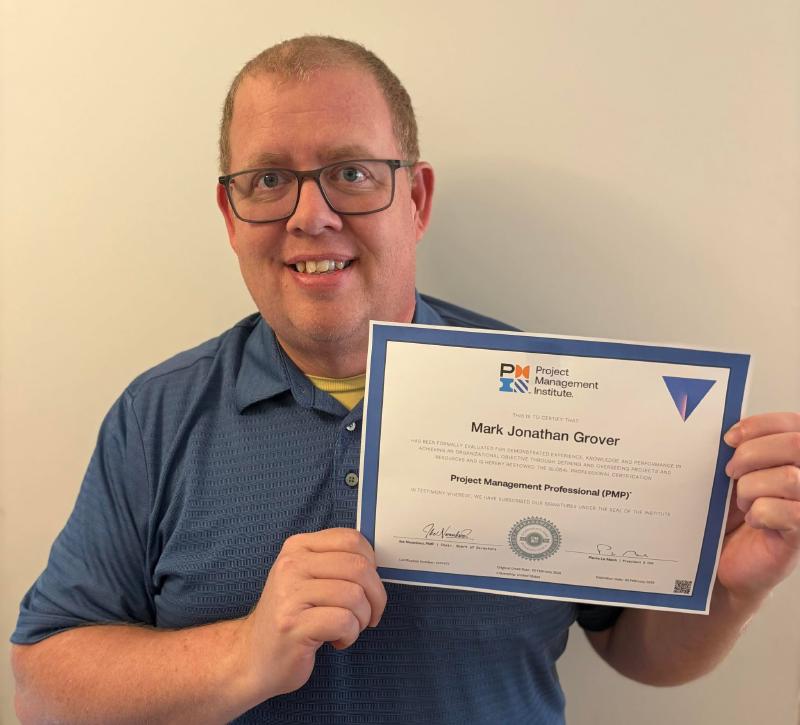
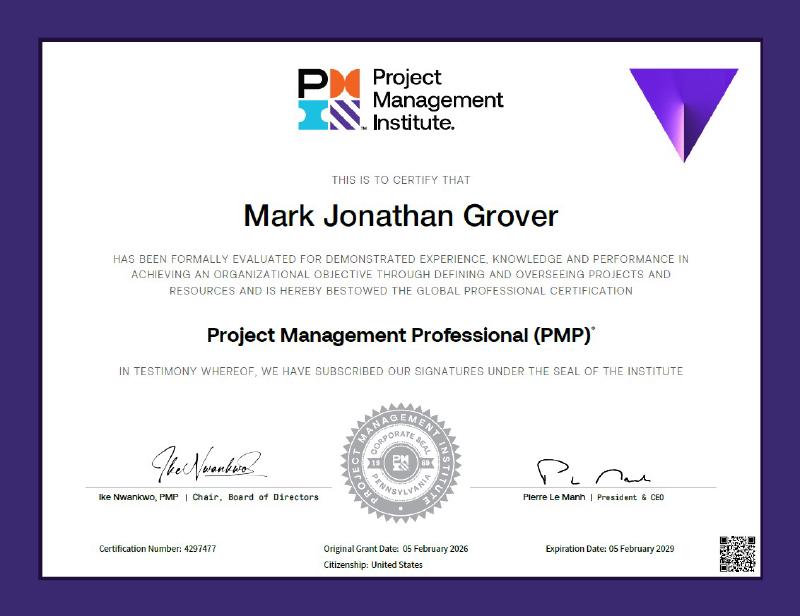
February 5, 2026 — the day I earned my PMP. A day I’ll remember for a while.
Earning the Project Management Professional (PMP)® certification isn’t something you just stumble into. It’s a deliberate, often grueling process of study, self-doubt, practice, more practice, and a fair amount of humbling yourself in front of 382 mock exam questions at a time. This is the story of how I got there — and the three people whose work made the difference.
Why the PMP?#
The PMP is widely regarded as the gold standard in project management credentials. It signals not just that you understand the theory, but that you’ve earned real-world experience managing projects and can demonstrate it. The exam itself is notoriously difficult — 180 situational questions designed to test whether you think like a project manager, not just memorize frameworks. About 50% of the content leans on agile and hybrid methodologies, the other half on predictive approaches. Passing above target across all three domains (People, Process, and Business Environment) requires internalizing an entire mindset shift.
Getting to the exam first required 35 hours of verified project management education. That’s where my journey really began.
Andrew Ramdayal: The Instructor Who Changes How You Think#
If you’ve spent any time in PMP prep circles, you’ve heard the name Andrew Ramdayal. He holds over 60 professional certifications in IT and accounting from vendors including Microsoft, Cisco, CompTIA, and PMI, and has a Master’s Degree in Management Information Systems with a minor in project management. He’s been teaching PMP and information security courses for over 20 years to thousands of students around the world.
What sets Andrew apart isn’t the credentials — it’s the methodology. He created the PMP Mindset framework used by thousands of certified professionals, an approach that teaches you to stop thinking like a student answering questions and start thinking like a seasoned project manager navigating real situations. That distinction matters enormously on an exam where almost every question is a scenario, not a definition lookup.
I completed Andrew’s PMP Certification Exam Prep Course — 35 PDU Contact Hours/PDU on Udemy (https://www.udemy.com/course/pmp-certification-exam-prep-course-pmbok-6th-edition/), taught through his TIA Education Group. The 35-hour course fulfilled my PMI education requirement, and by the end I walked away with both my contact hours certificate and, more importantly, a fundamentally different mental model for approaching project problems.
His Amazon bestselling PMP Study Guide has sold over 250,000 copies and helped more people pass the PMP exam than any other PMP book — and reading it alongside his video lectures made the content stick in a way that passive reading never would have. The combination of conceptual clarity and real-world grounding is what makes his teaching exceptional. You’re not just memorizing inputs, tools, and outputs — you’re learning why a project manager in a given situation would choose one path over another.
I purchased Andrew’s PMP Simulator for additional Mock Exams and found it invaluable (https://www.tiaexams.com/course/tiapmpsimulator). I especially appreciated the detailed video explanations for every question — not just the correct answer, but why the other choices are wrong. It included 10 mock exams, 1,100+ questions, and 30+ hours of video covering all three exam domains.
Nilotpal Ray: The Mock Exam That Humbles You (Constructively)#
Knowing the content is one thing. Surviving 150 back-to-back scenario questions under time pressure is another. For exam simulation, I turned to Nilotpal Ray — known online as PMPwithRay.
Nilotpal is a PMP and PRINCE2 certified project manager with over 12 years of work experience in the project management domain. His YouTube channel (PMPwithRay) has over 45,000 subscribers and 4 million views. He’s currently working as a Senior Project Manager with the National Health Service (NHS) in the UK, and he brings that real operational experience into every question he writes.
His PMP Exam-PMI 2026 Mock Simulator on Udemy (https://www.udemy.com/course/pmp-exam-situational-question-practice-test-200-q-pmbok6/) packs 382 questions across three practice sets: a diagnostic test, a full-length 180-question exam, and a bonus set. About 70–80% of the questions are situational in nature — exactly the style you encounter on the actual PMP exam. The rest cover newer syllabus topics like Servant Leadership, Personality Indicators, Minimum Viable Product (MVP), Disciplined Agile, Measurement of Training Outcomes, and Project Compliance.
What I appreciated most about Ray’s simulator was its honesty. These aren’t soft warm-up questions. They’re designed to surface exactly where your thinking goes wrong, and the Q&A forum lets you work through your errors with Ray himself. His “situational question framework” has become something of a legend among PMP candidates — multiple students have credited it as the key to their passing score.
After working through all 382 questions, tracking my errors, and revisiting the concepts I was getting wrong, I felt genuinely ready — not just rehearsed. Ray’s simulator earns its place in any serious PMP study plan.
Ricardo Vargas: The Flow That Made It All Click#
Some concepts in project management don’t fully land until you see them. That’s where Ricardo Viana Vargas came in.
Ricardo is, without exaggeration, one of the most accomplished figures in the global project management community. He has directed dozens of projects across industries and continents, managing more than $20 billion over the past 27 years. He received the PMI Fellow Award — the highest recognition from the Project Management Institute — and was the first Latin American Chairman of PMI worldwide. He’s also directed the United Nations Office for Project Services, leading over 1,000 humanitarian projects valued at $1.2 billion.
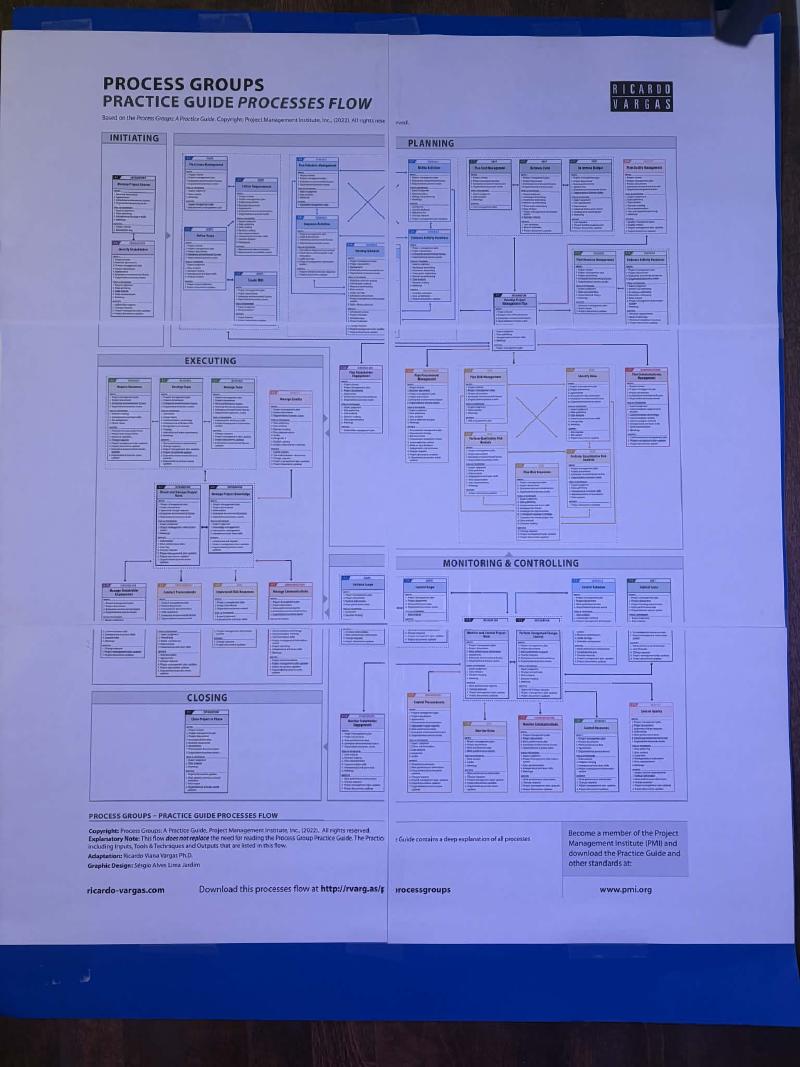
But for PMP candidates, Ricardo is perhaps best known for something deceptively simple: his PMBOK Processes Flow diagram. He originally created it in 1998 when he was studying for the PMP exam himself, and has updated it with each new PMBOK edition since. The color-coded visual maps every process group, knowledge area, input, tool, technique, and output into a single coherent reference — the kind of thing that transforms a wall of abstract text into a navigable architecture.
I downloaded the flow included in the ricardo_vargas_practice-guide_flow_color resource [https://ricardo-vargas.com/downloads/portfolio-management-processes-flow/] and printed it out as a poster, pasted it together, and spent a good amount of time with it in front of me, tracing the logical connections between processes. When the exam asks you why a change request in executing feeds back to the planning process group, or why a specific output from scope management becomes an input three knowledge areas later — that flow is the mental map that makes the answer feel intuitive rather than memorized.
Ricardo has emphasized that the flow doesn’t replace reading the PMBOK Guide — it facilitates understanding and application by providing a visual overview that serves as a quick reference for practitioners and students. That’s exactly how I used it: as the connective tissue between everything else I was studying.
The Stack That Got Me Across the Line#
In a little over a month I had:
- 35 contact hours completed and certified through Andrew Ramdayal’s TIA course
- 382 mock exam questions worked through via Nilotpal Ray’s PMBOK7 simulator
- A deep familiarity with Ricardo Vargas’s process flow diagram, used as a visual anchor throughout
- A supplemental reference in the Project Management Professional Master Cheat Sheet, covering all three exam domains — People (42%), Process (50%), and Business Environment (8%). I don’t recall the website I got the Master Chat Sheet from, so unfortunately I can’t give proper attribution. If you are the owner of this document, please let me know so I can give proper attribution. [Download the cheat sheet] This was a good resource for breaking down each individual tasks into short digestible review.
- I read a bunch of Reddit threads and gleaned additional recommendations and feedback from other Redditors. Although Andrew was my authoritative “instructor” for all my formal learning, I also found Mohammed Rahman’s Mindset Principles helpful [Download the principles].
The exam itself was everything the mock tests prepared me for: relentless situational scenarios, questions where two answers look equally reasonable and you have to choose the most correct one, and a constant demand to think from the project manager’s perspective rather than your own instincts.
Passing it felt earned.
What I’d Tell Someone Starting Today#
If you’re preparing for your PMP, here’s what worked for me:
Start with Andrew Ramdayal. His 35-hour Udemy course is both your required education hours and your conceptual foundation. Don’t rush it. The “PM Mindset” he teaches is the entire point.
Stress-test yourself with Nilotpal Ray’s simulator. Do the diagnostic first to find your weak spots, then work through the full exam under timed conditions. Review every wrong answer — not just the right answer, but why the other options were wrong.
Print Ricardo Vargas’s flow diagram. Tape it to your wall. Refer to it constantly. When something in the PMBOK doesn’t make sense in isolation, find it on the flow and look at what it connects to.
The PMP isn’t just a credential. The process of earning it genuinely changed how I think about project work — how I frame problems, prioritize responses, and consider the ripple effects of decisions across scope, schedule, cost, and people. That, more than the letters after my name, is the real return on the investment.
If you’re on your own PMP journey and have questions about any of these resources, feel free to reach out.